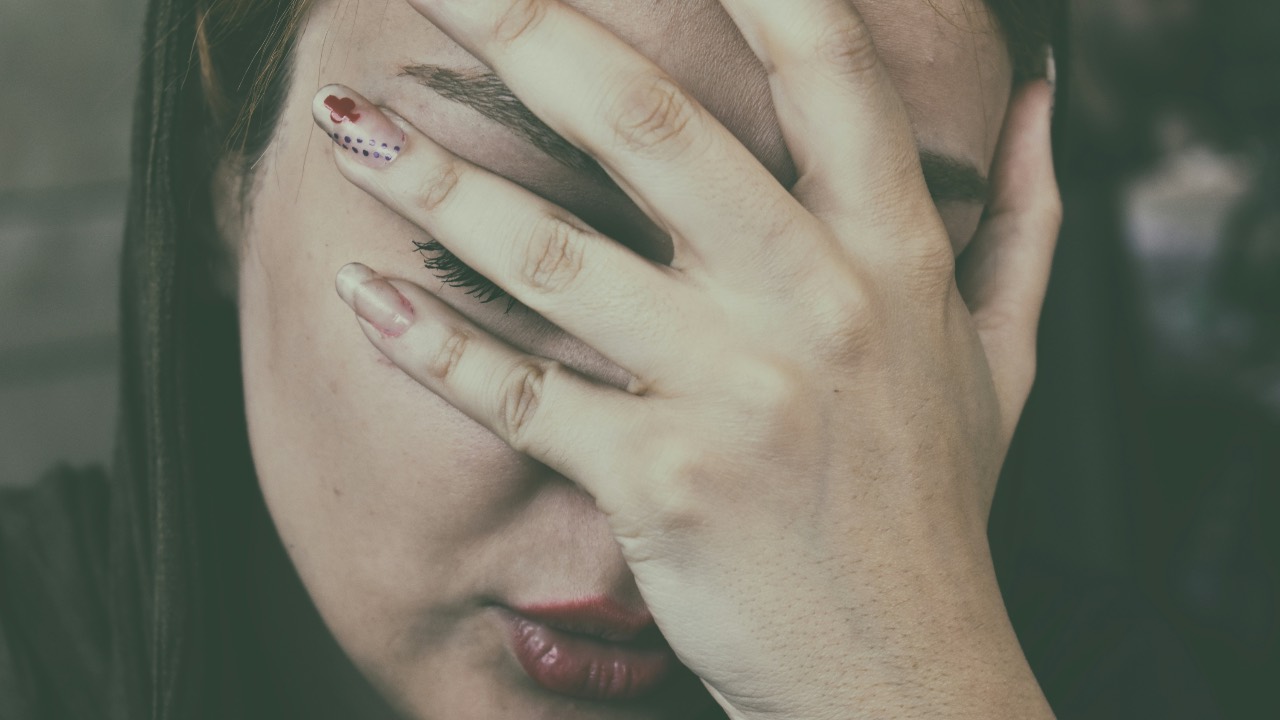
When We Were Taught to Swallow Down — Suffering, Systems & the Slow Work of Coming Back
Mar 08, 2026
✨ Before you read:✨
Today is International Women's Day — a global reminder of the power, resilience, and truth that lives inside every woman.
In honor of that spirit, I’m sharing one of my recent Love Letters here on the blog.
If you aren’t on my newsletter list yet, you’re missing out on this level of witnessing, reflection, and truth — the kind of space where women remember who they really are.
You can sign up at the bottom of this page. I love you. ✨
Darling,
There is something most of us were taught before we were old enough to question it. Something passed down not in words, but in glances, in silences, in the way a room shifted when we cried too long or wanted too much.
We were taught to swallow down our emotions.
To take whatever was rising — grief, rage, longing, the aching need to be truly seen — and press it back down. To smooth our faces. To say "I'm fine" with a precision that became, over time, almost automatic. To keep moving, keep functioning, keep being palatable to a world that found our full humanity a little too much to hold.
This is important, darling, because what I see in so many of us — and what I have lived in myself — is the confusion that comes from mistaking that survival strategy for a personality. We believe we are simply "not very emotional" people. We believe we are "strong." We believe that what we feel, when we allow ourselves to feel it, is an overreaction.
But here is the truth: swallowing down your suffering takes enormous work. The fact that you make it look effortless is not proof that you don't feel. It's proof of how hard you've been working.
It's Not Just You. It's the Architecture.
Here is something I want you to really sit with: the pressure to swallow down your suffering is not only personal. It is structural. It is built into the systems we move through every day.
Workplaces reward output, not humanity. There is rarely space to grieve, to rest, to fall apart and be rebuilt. The message is constant: your value is in your productivity. Your pain is a liability.
Medicine and healthcare, too often, treats the symptom and not the person. Many of us have learned to minimize what we bring to appointments — we edit ourselves before we even arrive, afraid of being too much, afraid of not being believed.
Gender asks us to disappear ourselves in different ways. Those of us socialized as women are told we are too emotional — our pain rebranded as hysteria or sensitivity. Those socialized as men are told to have no emotional needs at all. Both of these are a kind of violence. Both produce people who have become experts at swallowing down.
And for those of us who carry marginalized identities — race, class, sexuality, disability — the world has made explicitly clear, in a thousand ways, that our suffering is less credible, less worthy, or outright dangerous to express. Silence becomes survival. Strength becomes armor.
Systems are not neutral. They are designed — often quite deliberately — to keep certain people small, compliant, and too exhausted to ask for more.
When we understand this, something shifts. Instead of turning inward with shame — "why can't I just cope?" — we can begin to see that our struggles exist in a context. That we have been swimming upstream. That there was never anything wrong with us for finding it hard.
What Swallowing Down Does to the Body
Unfelt pain does not disappear. The body keeps a meticulous, patient record of everything we have pressed back down.
It shows up as tension that sleep doesn't fix. Fatigue that stretches across years. Anxiety that feels sourceless. A quiet numbness — a kind of gray weather that settles over your life. Difficulty trusting your own perceptions. A loneliness that persists even when you are not alone.
This is not weakness. This is what happens when a person is asked, for long enough, to act as though they are not a person.
And for many of us, the swallowing down is not a simple habit — it is a trauma response. A physiological adaptation that developed in the face of real danger. The nervous system learned that it was safer to numb, to disconnect, to press on. That wisdom kept you going. It also has a cost.
✨ This week's practice:
Notice where in your body you hold things unsaid. Not in your mind — in your body. The tightness in your jaw. The weight across your shoulders. The hollow place in your chest. Sit with one of these sensations for just two minutes this week — not to fix it, not to explain it, but simply to be present with what has been present with you for a very long time. That is not a small thing. That is the beginning of everything.
Beginning to Stop Swallowing Down
I want to be honest with you: this is not simple work. Parts of us have been keeping the lid on things for very good reasons. Moving toward your own pain requires safety, pacing, and support. This is not a prescription. Think of it as an invitation.
Notice before you change. The first step is not to feel more — it is to notice the moment you move away from a feeling. The reach for your phone. The glass of wine. The sudden busyness. The "I'm fine" that arrives before the question is even finished. Noticing without judgment is the beginning of everything.
Name what is present. We are more comfortable solving than feeling. See if you can practice saying: "I notice I feel sad. There is grief here. I am carrying a lot of fear right now." Not to fix it. Not to explain it. Just to acknowledge it as real. Real things can be worked with.
Question the voice that says you're too much. When it says "stop being so sensitive" or "other people have it worse" — get curious. Whose voice is that? What was it protecting? You are allowed to feel things. Pain is not a competition, and you were never meant to earn the right to be hurt.
Find places where it is safe to be honest. Therapy, trusted relationships, creative expression, time in your body, time in nature — these are containers. Places where what has been held can begin to move. You do not have to do this alone. You were never meant to.
🖊️ Journaling Prompts:
- When did I first learn that my pain was inconvenient to others — and what did I do with it?
- What am I currently swallowing down that deserves to be felt, spoken, or witnessed?
- Where in my life has a system — work, family, society — asked me to be smaller than I am? How has that shaped me?
- If my suffering were allowed to speak without shame, what would it say?
So this is a love letter to the part of you who learned — early and well — that the safest thing was to make yourself quiet.
To the part of you who held it all together when everything in you wanted to fall apart.
To the part of you who is only now beginning to understand that what you were asked to swallow down was never yours to carry.
She is learning to let it rise. She is learning that her feelings are not a burden — they are a compass. She is remembering that her body was never the enemy, and that the systems that asked her to betray it were wrong.
And she is worthy of a world — and a life — where she doesn't have to disappear herself to belong.
💜 Em
P.S. If something in this letter cracked something open — I want to hear about it. What is it that you've been swallowing down? What would it mean to stop?
And if you’re feeling the call to go deeper, this is exactly the work we’ll be doing inside my new program Rewire & Rise— where we untangle the old stories, shift the patterns that keep you stuck, and reconnect you with the woman you’re meant to be.
If that speaks to you, I’d love to have you there. 💜⚡